March 22, 2026
If the last six years have taught me anything — and they’ve taught me a lot — it’s this:
- The human body is being hijacked from all angles.
- Don’t trust big narratives.
- Go inward. Develop the intuition to know what’s right for you.
And yet, for a while, I wasn’t fully living by those principles. Not when it came to supplementation. That was my blind spot. And creatine was sitting right at the centre of it.
I’ve spent 32 years training drug-free. Natural bodybuilding isn’t just a method for me — it’s a philosophy. It’s a commitment to working with the body, not around it. So how did I end up in the same trap as everyone else?
Simple. I got caught up in the optimisation game.
As someone who has always been obsessed with unlocking the true potential of the human body, I got seduced by the question: what can I take to get more from this? More strength. More recovery. More muscle. Feel younger, sharper, more alive. And creatine ticked every box the research pointed to. It was — and still is — one of the most hyped, most studied, most universally recommended supplements on the planet.
So I didn’t question it. I just took it.
Until I watched this:
What happened to Natural
I never considered steroids as I never wanted to bypass the bodies own testosterone production, Peptides (the latest fad) same thing, a synthetic version of a natural compound, no thank you, So why would supplements be any different?
Here’s What I Missed About Creatine
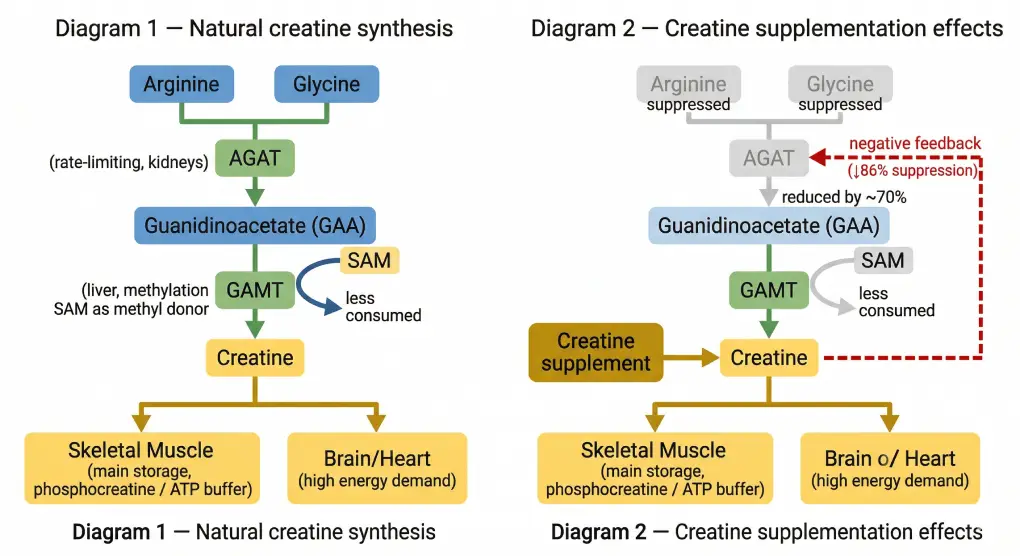
Your body makes creatine. It does it naturally, primarily in the liver and kidneys, using the amino acids arginine and glycine. The enzyme that kicks this process off is called AGAT — arginine:glycine amidinotransferase. When your body needs creatine, AGAT gets activated, the process runs, and creatine gets produced and shuttled to where it’s needed.
Now here’s where it gets interesting — and why I can’t un-see this.
When you supplement with exogenous creatine, your body detects elevated levels and responds logically: it suppresses AGAT activity. Why produce something you’re already getting from outside? It downregulates its own production. You’ve effectively told your body’s internal creatine factory to stand down.
The question nobody seems to be asking is: what happens to that factory over time? What happens to that enzymatic pathway when it’s been bypassed for months, years, decades? There are no long-term studies that answer this. None. We simply don’t know what consistent exogenous creatine does to your body’s endogenous production capacity — or whether it ever fully comes back online.
But it doesn’t stop there. Creatine synthesis is tied into your methylation system — one of the most critical biochemical processes in the human body. Methylation governs everything from gene expression to neurotransmitter production, detoxification, immune response, and cardiovascular health. Your body uses a methyl donor called SAM-e to complete the creatine synthesis process. When you’re making creatine naturally, this is part of a balanced, integrated cycle.
When you bypass that cycle with a synthetic supplement, you’re not just skipping a step. You’re potentially disrupting the rhythm of a system that governs far more than muscle energy. No long-term studies. No honest conversation about methylation burden. Just: it’s safe, it’s studied, take it.
I’m not prepared to accept that anymore.
And Then the Rest of the Pieces Fell
Once I pulled on that thread, I couldn’t stop. Because the same pattern is everywhere.
Take zinc. Zinc supplementation is heavily promoted — testosterone support, immune function, hormone optimisation. I’ve recommended it. I’ve taken it. But here’s what often gets buried in the small print: supplementing with zinc depletes copper. These two minerals compete for the same absorption pathways. Push zinc up artificially and copper gets crowded out.
Why does that matter? Because copper is essential. It plays a critical role in iron metabolism and the formation of red blood cells. It’s foundational to collagen and elastin production — the structural integrity of your connective tissue, skin, and blood vessels. It’s needed for proper mitochondrial function, neurological health, and the activity of superoxide dismutase — one of your body’s most powerful antioxidant enzymes. A copper deficiency doesn’t announce itself dramatically. It creeps. Fatigue, anaemia, compromised connective tissue, neurological dysfunction. All while you think you’re optimising.
This is what happens when we treat the body like a machine with isolated parts to upgrade, rather than an integrated, intelligent system where every intervention has a downstream consequence.
And the list goes on. This isn’t an isolated phenomenon. It’s a pattern. Supplement culture — even the “clean” end of it — has a habit of selling you the benefit and burying the tradeoff.
Where I Stand Now
I’ve spent six years dismantling the stories I was handed about health, the body, and how to live. Terrain theory over germ theory. Whole food over isolated nutrient. Signal over noise. And yet in the supplementation space, I hadn’t applied the same rigour. I was still operating from an old programme — the one that says more is better, optimise everything, trust the science consensus.
I’m done with that.
As a natural bodybuilder, as someone who lives clean and thinks deeply about what goes into this body, I’m taking it up another level. The next chapter is about trusting the body’s innate intelligence first — and only intervening when there’s a clear, honest, full-picture reason to do so.
I got it wrong. I’m course-correcting.
Keep an eye out. There’s more to come on this.
Related: Vitamin D for Athletes: Enhancing Performance and Recovery